
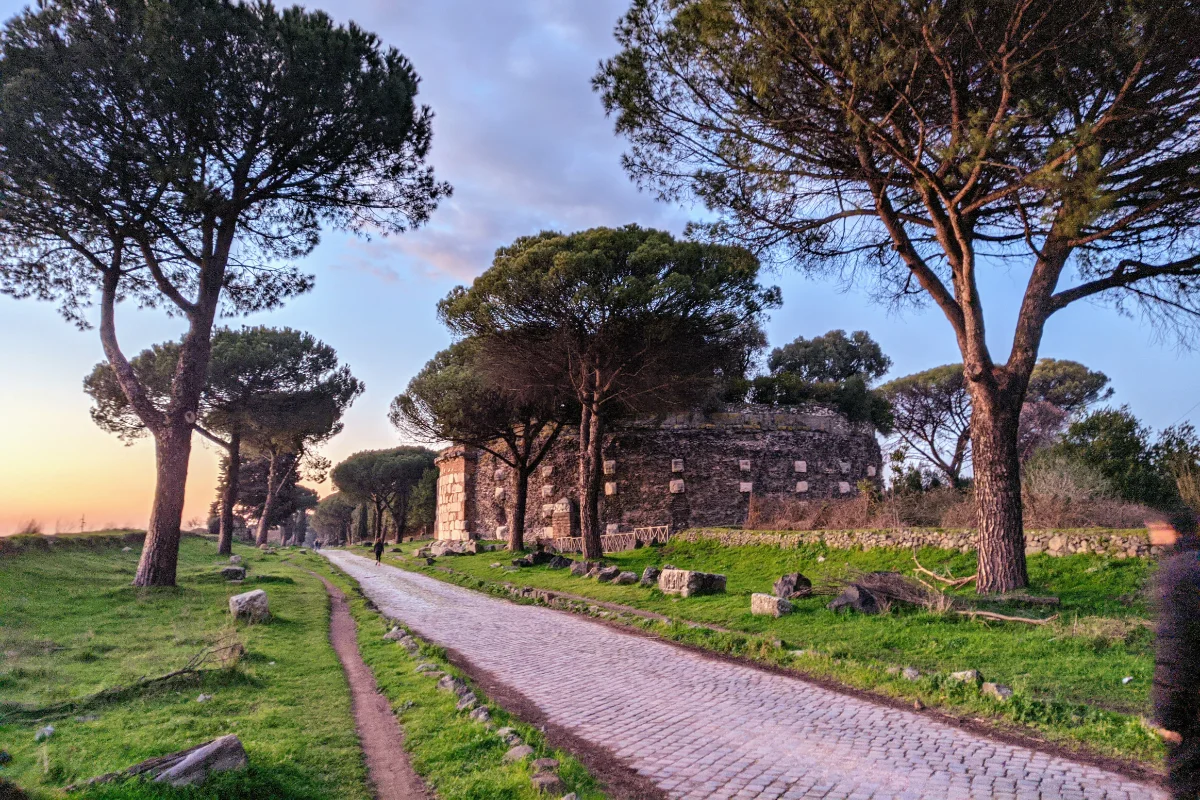
Ancient road, catacombs and countryside atmosphere close to the city. This guide is evergreen travel content focused on context, atmosphere, what to notice and how to include the place in a realistic Rome itinerary.
Why it matters
The Appian Way, or Via Appia Antica, is one of the most important roads ever built by ancient Rome. Begun in 312 BC under the censor Appius Claudius Caecus, it was designed first as a strategic military route leading south from Rome. Over time it became much more than a road: it connected cities, moved armies, carried goods, shaped landscapes and helped Rome project power far beyond the city walls.
Romans called it the Regina Viarum, the “Queen of Roads”, because of its scale, durability and influence. The route originally connected Rome with Capua and was later extended toward Brindisi, a major port for travel and trade across the Adriatic and toward the eastern Mediterranean. In practical terms, the Appian Way helped turn Rome from a regional power into the center of a wider Mediterranean network.
What makes the Appian Way especially memorable today is that it does not feel like a museum room. It is an open-air landscape where ancient paving stones, Roman tombs, early Christian catacombs, villas, aqueduct views, umbrella pines and rural stretches sit side by side. Visiting it gives you a different sense of Rome: quieter, older, wider and less theatrical than the famous squares of the historic center.
The road also matters because it shows Roman engineering at human scale. You can still understand how a road was laid out, how funerary monuments lined the approach to the city, and how infrastructure, memory and power were combined in a single landscape. After seeing the Colosseum and the Roman Forum, the Appian Way helps complete the picture of ancient Rome as a living system of movement, communication and territory.
A short history of the Appian Way
The first section of the Appian Way was built during the Roman Republic, at a time when Rome was expanding its control in central and southern Italy. Its construction was ambitious: the road was planned to be direct, solid and efficient, cutting through difficult terrain and allowing troops and supplies to move faster than before. This was not simply a convenience for travelers; it was a tool of state power.
As Rome grew, the road became a corridor of trade, administration and culture. Merchants used it, soldiers marched along it, officials traveled between cities, and communities developed around it. The road’s paving, drainage and alignment became a model for later Roman roads, many of which copied the principle of direct routes supported by strong foundations.
In the Roman world, important roads outside city gates were often lined with tombs because burials were generally placed beyond the inhabited center. This is why the Appian Way is surrounded by funerary monuments, mausoleums and memorials. The most famous include the Tomb of Cecilia Metella, a massive cylindrical mausoleum that still dominates the landscape, and many smaller tombs that remind visitors how Roman families used architecture to preserve status and memory.
The road also has a deep connection with early Christianity. Several catacomb complexes lie in the area, including the Catacombs of San Callisto and San Sebastiano. These underground burial places reveal another layer of Roman history: not imperial triumph, but community, faith, ritual and remembrance. For visitors interested in sacred history, the Appian Way pairs naturally with churches such as Santa Maria Maggiore and with the broader story of Christian Rome around the Vatican.
In later centuries, parts of the ancient road fell into decline, were reused, restored or absorbed into the countryside around Rome. The result today is a layered archaeological park rather than a single isolated monument. In 2024, the Via Appia, known as Regina Viarum, was inscribed on the UNESCO World Heritage List, recognizing its exceptional importance as ancient infrastructure and cultural landscape.
How the Appian Way is used today
Today the Appian Way is both an archaeological area and a beloved green escape from central Rome. Locals and visitors use it for walking, cycling, photography, guided tours and slow exploration. It is one of the best places in the city to feel space around you: instead of moving from one crowded landmark to another, you follow a historic route through fragments of countryside, ruins and quiet lanes.
The area is part of a protected park landscape, so the experience is different from visiting a ticketed monument with a single entrance and exit. Some sites along the road require tickets or have specific opening hours, while the road itself can be explored as a walk. This makes it flexible: you can visit for a short atmospheric stroll, a half-day itinerary, or a longer route by bike.
For many travelers, the Appian Way works best as a counterpoint to the busy historic center. After a day around the Pantheon, Piazza Navona and the Trevi Fountain, the ancient road offers open air, long views and a slower pace. It is still Rome, but it feels closer to the countryside and to the physical traces of antiquity.
What to see
- Ancient paving stones: in several stretches you can still see the heavy basalt blocks associated with Roman road building. They are uneven, atmospheric and very photogenic, but they also remind you to wear proper shoes.
- Porta San Sebastiano: one of the great gates in the Aurelian Walls and a strong starting point for understanding how the road left ancient Rome.
- Church of Domine Quo Vadis: a small church connected with one of the most famous Christian legends of the Appian Way.
- Catacombs of San Callisto and San Sebastiano: underground burial complexes that reveal the early Christian history of Rome. Check official schedules before planning a visit, as access is normally controlled by timed visits or guided routes.
- Tomb of Cecilia Metella: one of the most recognizable monuments on the road, combining Roman funerary architecture with later medieval reuse.
- Villa and circus landscapes: remains of elite villas, towers, walls and open fields show how the road became a prestigious corridor outside the city.
- Long countryside views: the Appian Way is not only about individual ruins. The most powerful part of the visit is often the landscape itself: stone road, pine trees, walls, grass, silence and distance.
Why you should visit
Visit the Appian Way if you want to understand Rome beyond its postcard icons. The historic center shows you temples, churches, fountains and palaces; the Appian Way shows you movement, memory and expansion. It explains how Rome connected itself to the rest of Italy and how infrastructure became part of its identity.
It is also one of the most rewarding places in Rome for travelers who enjoy walking. The route encourages you to slow down, look closely and connect separate historical periods. A single walk can include Republican road engineering, imperial tombs, early Christian burial sites, medieval towers and modern Romans cycling through the park.
Photographers will enjoy the textures: dark stones, pale ruins, cypress and pine trees, fragments of brickwork and changing light. Families may enjoy the space and the feeling of discovery, though the uneven stones can be tiring for very young children. History lovers should allow more time than expected, because the road is full of details that are easy to miss if you rush.
What to expect during your visit
Expect a visit that feels more like a walk through a historic landscape than a standard attraction. There may not always be dense signage at every point, and distances can feel longer than they look on a map. This is part of the experience: the Appian Way is best approached as a route, not as a single monument to check off a list.
The ground can be uneven, especially where ancient stones are exposed. Comfortable shoes are essential. In warm months, shade can be limited in some stretches, so water, sunscreen and a hat are useful. In cooler months, the road can be wonderfully atmospheric, especially when the light is low and the crowds are thinner.
If you plan to visit catacombs or specific archaeological sites along the way, check their official opening times before you go. Some places close on certain days or require guided entry. If your goal is simply to experience the road, you can enjoy a flexible walk without entering every monument.
Suggested walking route
A simple first-time route is to begin near Porta San Sebastiano, continue toward the Church of Domine Quo Vadis, and then follow the road toward the catacomb area and the Tomb of Cecilia Metella. This gives you a clear progression from city gate to sacred memory, funerary monuments and open countryside.
If you have limited time, choose a shorter section and focus on atmosphere rather than distance. If you have half a day, combine the Appian Way with a catacomb visit and a slow walk beyond the busiest first stretch. For travelers building an ancient Rome itinerary, it pairs well with the Baths of Caracalla, the Colosseum and the Roman Forum.
Helpful tips
Go early if you want softer light and a quieter walk. Sundays and public holidays can be especially pleasant for walking or cycling because traffic restrictions often make the area feel calmer, but always check local conditions before relying on this. Bring water, wear shoes with good soles and avoid trying to combine too many distant sights in the same afternoon.
Do not treat the Appian Way as a quick photo stop. Its value is in the sequence: road, wall, tomb, field, church, catacomb, villa and horizon. Give yourself time to walk slowly and let the landscape explain itself. If you are planning a longer Rome stay, consider adding it to a relaxed itinerary such as Rome in 3 days or Rome in 5 days rather than forcing it into a rushed one-day route.
For an easier visit, decide in advance whether your priority is a scenic walk, a bike ride, catacombs, archaeology or photography. Each version of the Appian Way is slightly different, and choosing a focus will help you enjoy it more. If you love quieter historic corners, continue exploring with our guide to ancient Rome walking routes or browse more Rome attractions.